Animus Rifts Guide: Navigating What-If Scenarios and Rewards in Black Flag Resynced
Assassin’s Creed Black Flag Resynced is built on the promise of modernizing the golden age of piracy from the ground up on the latest Animus engine. While the core journey of Edward Kenway and the Jackdaw remains incredibly faithful to its roots, Ubisoft Singapore has introduced entirely new mechanics that leverage the modern-day framing of the franchise. The most prominent and heavily discussed of these new features is the inclusion of Animus Rifts.
Unlike the linear memory sequencing seen in the 2013 original, these Rifts are dynamic digital anomalies scattered across the Caribbean. They serve as pocket dimensions offering distinct “what-if” scenarios, bending the established historical narrative to create unique gameplay challenges. Whether you are aiming for total map completion, trying to understand the lore implications, or fighting through the notorious RNG hurdles to claim your Platinum trophy, mastering the Animus Rifts is a fundamental part of the endgame.
This guide covers everything you need to know about locating these Rifts, completing their unique gameplay loops, handling the controversial combat restrictions, and troubleshooting technical issues on PC and Linux platforms.
What Are Animus Rifts in Resynced?
In the modern-day storyline of Black Flag Resynced, Abstergo Entertainment is aggressively manipulating genetic memories to produce consumer-facing historical media. (For a deep dive into the modern-day characters and lore, check out our story overview). However, the Animus engine is inherently unstable when forced to simulate alternate timelines. Animus Rifts are the direct result of this instability.
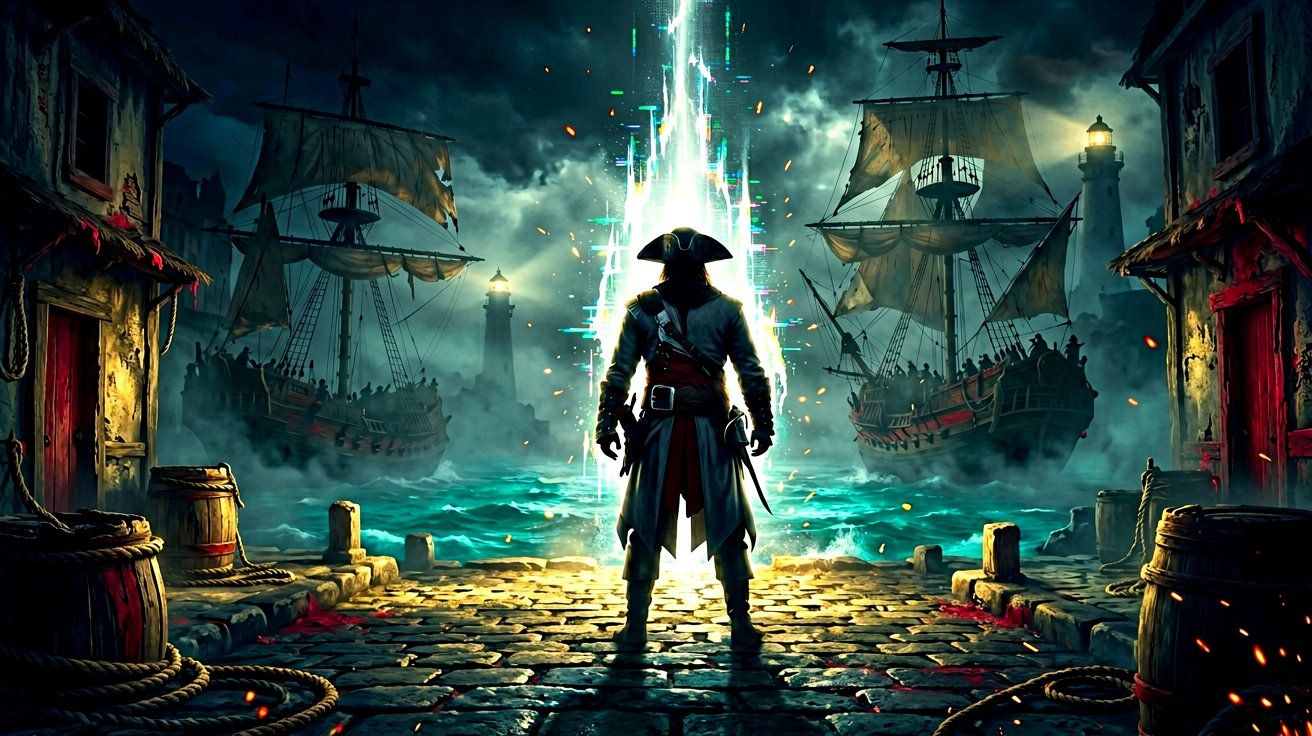
These Rifts physically manifest in the game world as glitching, luminous tears in reality. When Edward steps into one of these tears, the familiar environment of Havana, Kingston, or Nassau shatters. The simulation shifts into a hypothetical “what-if” scenario engineered by Abstergo. According to community feedback, these alternate realities have vastly exceeded expectations, presenting narrative deviations that explore what might have happened if certain pirate legends had survived the gallows, or if the Templar Order had secured the Caribbean decades earlier.
These environments are visually striking. The skyboxes often fracture, revealing lines of raw code, while gravity and guard behaviors operate under completely different rule sets. You are no longer just fighting British or Spanish colonial forces; you are fighting the internal logic of the Animus itself.
Locating and Accessing the Anomalies
Animus Rifts are not handed to you on a silver platter. They do not appear automatically on your world map when you first dock at a new island. Instead, they require active exploration and synchronization.
To reveal a Rift, you must first synchronize the viewpoints in a specific region. Even then, the Rifts often remain hidden until you get within a certain proximity, marked only by a faint, high-pitched digital hum that cuts through the ambient ocean noise. Many players have reported finding the most challenging Rifts tucked away in dense jungle ruins or high above colonial fortresses, forcing you to utilize the revamped traversal mechanics to reach them. If you are struggling with the new climbing mechanics, review our parkour guide to smooth out your movement flow.
Once activated, you are immediately seamlessly loaded into the challenge. There are no lengthy loading screens, but you cannot manually save while inside a Rift. If you desynchronize, you will be sent back to the start of the sequence.
Surviving the What-If Scenarios
The challenges presented inside Animus Rifts are typically broken down into three distinct categories, each testing a different pillar of the game’s core mechanics.
1. Environmental and Traversal Puzzles
The most common Rift type involves a collapsing simulation where the environment is actively deteriorating around you. You must navigate a floating, disjointed version of a Caribbean settlement. These require precise timing and an understanding of the new momentum-based movement. You will need to chain together wall-runs, precise leaps, and vaulting maneuvers before the simulation catches up and deletes the platforms beneath your boots.
2. Pure Stealth Gauntlets
In these scenarios, Abstergo’s simulation rules are unforgiving. You are placed into a heavily guarded alternate-reality fortress. The catch? Detection results in immediate desynchronization. You must utilize every tool in your arsenal—smoke bombs, sleep darts, and environmental cover. The improved enemy AI means guards will investigate shadows and communicate with one another, so understanding line-of-sight is critical. For advanced tips on remaining unseen, consult our stealth breakdown.
3. Combat Arenas
The most polarizing of the Rift challenges are the combat arenas. Here, you are swarmed by waves of digital Templar enforcers. You are forced to rely heavily on the new parry-centric swordplay. Knowing when to counter and when to break defense is the only way to survive the escalating numbers. Familiarize yourself with the timing windows detailed in our combat guide.
Community Backlash: The Hidden Blade Restriction
While the narrative execution of the what-if scenarios has been praised, the gameplay mechanics tied to them have sparked significant debate within the community. The core issue revolves around forced loadout restrictions.
In many Animus Rifts, the game arbitrarily locks access to your Hidden Blades and unarmed combat options. Players are forced to rely solely on dual swords or standard firearms. As noted by frustrated players on community forums, the inability to freely use the Hidden Blade—the most iconic weapon in the franchise—feels entirely counterintuitive, especially in scenarios that demand silent takedowns.
This controversy is essentially a continuation of the friction surrounding the broader engine changes. Ubisoft Singapore had already heavily modified how assassinations trigger in the open world, a topic we covered previously in our report on how Ubisoft reworks hidden blades in Assassin’s Creed Black Flag Resynced. Furthermore, PC players are already utilizing external modifications to bypass these restrictions, similar to the widespread usage of the PC mod guide to restore unarmed combat.
The community is actively requesting a patch to lift these restrictions. Until Ubisoft addresses this, players must adapt to the sword-heavy requirements of the combat-focused Rifts.
The Dilettante Trophy RNG Trap
For completionists, Animus Rifts are a necessary evil. Completing them rewards you with database entries, alternate cosmetic sails for the Jackdaw, and unique outfits for Edward. However, they also tie into some of the most grueling achievements in the game.
Recently, players celebrating their Platinum trophy milestones have issued warnings regarding the “Dilettante” trophy. While Black Flag Resynced is generally praised for having a reasonable and enjoyable completion path, the Dilettante requirement relies heavily on extreme RNG (Random Number Generation). Because the rewards and specific enemy spawns within certain procedural Rifts pull from a massive randomized pool, you can easily spend upwards of a dozen hours grinding the same Rifts repeatedly just to get the specific scenario spawn required for the trophy.
If you are aiming for 100% completion, do not leave this trophy for last. Engage with every Animus Rift you find immediately as you progress through the main story to naturally increase your chances of rolling the necessary RNG outcomes. For more strategies on mitigating completionist grinds, check out our community update on avoiding the Dilettante trap.
Troubleshooting: Large Area Freezes on Linux and Steam Deck
For PC and Steam Deck players, the Animus Rifts can introduce severe technical hiccups. Because these sequences often load entirely new, uncompressed asset structures on top of the existing open world, they demand significant memory bandwidth.
Linux gamers running modern distributions (such as Fedora 44) alongside Proton Experimental have reported a critical bug. When transitioning into massive, open-layout Animus Rifts—or simply entering densely populated large areas in the main map—the game freezes completely after roughly five seconds of gameplay.
This is reportedly a shader compilation deadlock specifically tied to the Proton Experimental branch. If you encounter this total freeze:
- Force close the game.
- Navigate to the game’s properties in your Steam library.
- Switch your compatibility tool from Proton Experimental back to a stable, older branch (such as Proton 9.0 or GE-Proton).
- Allow Steam to rebuild the shader cache before launching.
For a broader look at performance tuning across Linux platforms, read our troubleshooting guide for Linux stutters.
Conclusion
The Animus Rifts add an exciting layer of theoretical history to the Caribbean, allowing Ubisoft Singapore to flex their creative muscles without breaking the established canon of the Assassin’s Creed universe. While the forced weapon restrictions and RNG grinds may test your patience, the rewards and the fascinating glimpses into alternate timelines make hunting down these anomalies well worth the effort. Equip your best swords, optimize your hardware settings, and prepare to step into the unknown.
Sources
← Back to News